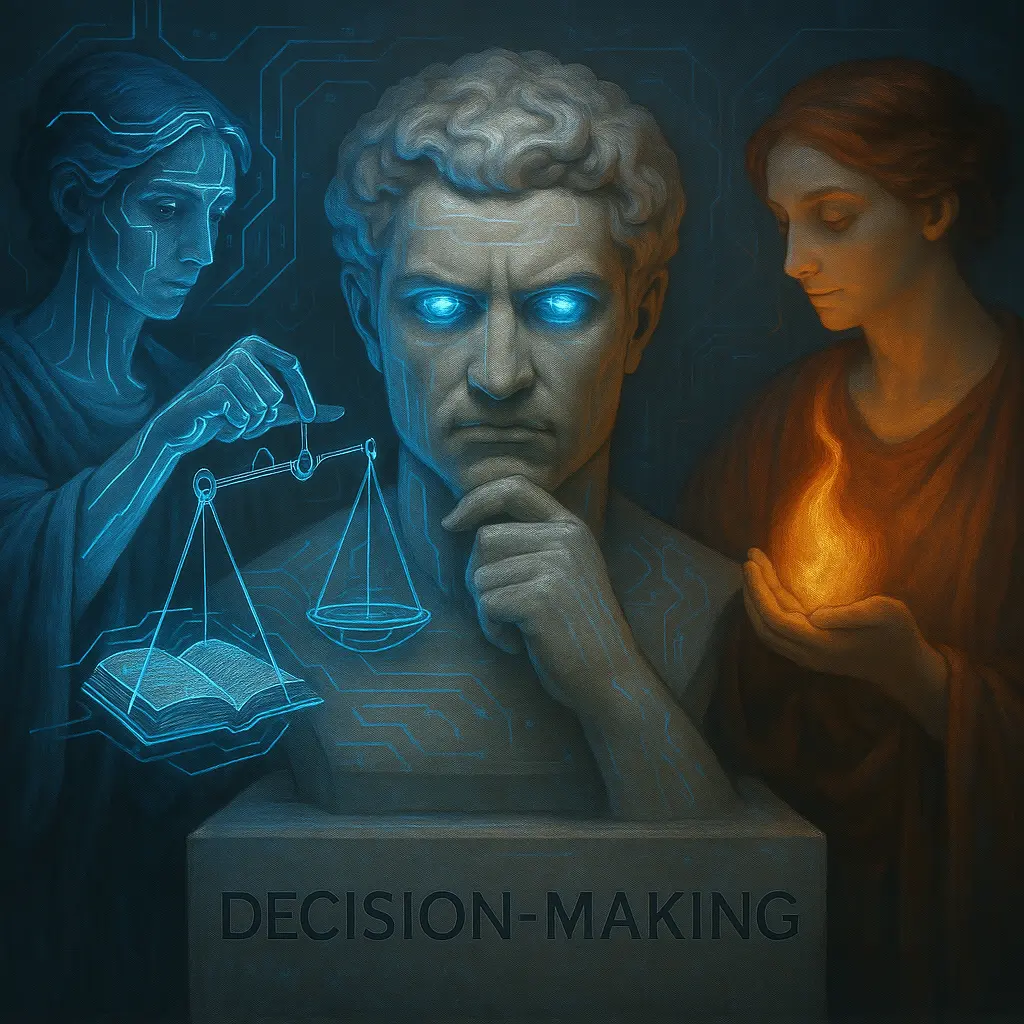
Rules vs. Intuition: Finding Wisdom in Balance
The Nature of Rules and Their Purpose in Society
Our philosophy café explored how rules build social cooperation while sometimes becoming
roadblocks to progress. We discussed how grammar rules help us communicate clearly, while many bureaucratic
regulations made us wonder who actually benefits from them . The work of Philip Pettit sheds light
on what we discovered—good rules protect people from arbitrary power rather than reinforcing it.
Durkheim's research helps explain why even seemingly pointless rules might serve deeper social needs.
Our group struggled with this tension: rules prevent selfish behavior and solve conflicts efficiently, but the
longer they stay unchanged, the more likely they become harmful constraints.
Practical Application: When dealing with a frustrating rule, think about both its obvious
purpose and hidden functions. Ask yourself: "Who really benefits from this rule?" and "What would happen if
everyone ignored it?" This simple check often reveals whether a rule remains in serving the common good.
Power Dynamics and Rule Enforcement
Our conversation naturally moved to questions of enforcement. Foucault's studies
of power reveal how inconsistently applied rules strengthen existing social hierarchies. We examined a
particularly striking example where a minister organized a wedding during COVID restrictions, then hastily lifted
them only after public outrage over his hypocrisy. He didn't benefit from creating the
rule; he simply exempted himself from a standard he expected others to follow. Robert Dahl's research
on democracy extends this thinking by showing that without inclusive ways to update rules, outdated norms become
stuck in place.
Practical Application: Before breaking a rule, ask if you'd be comfortable with everyone having
the same exception. If you enforce rules for others, regularly check your own behavior for consistency. This builds
the trust and fairness that makes rule systems work for everyone.
Intuition as Lived Experience
Our discussion shifted to intuition as Herbert Simon's research offers a clear
way to understand what many had experienced—how accumulated knowledge becomes automatic responses that skip
conscious thought. We shared a story about scientists who break traditional methods because their deep
understanding lets them know when breaking the rules will lead to breakthroughs.
Kahneman's work on fast "gut feeling" thinking versus slow deliberate thinking helps explain why
intuition works differently across situations. Through this lens, intuition isn't the opposite of rules but
their internalization—knowledge that becomes so natural we don't need to think about it.
Practical Application: To build reliable intuition, seek varied experiences rather than just
putting in time. When making decisions, be honest about where you have real expertise versus areas where you're
still learning. Trust your gut more in fields where you've faced different challenges and gotten honest feedback
about your results.
The Limitations of Both Approaches
Our café conversation revealed that neither rules nor intuition alone gives us a complete
toolkit for wise decisions. Kauffman's theory of "fitness landscapes" gives a helpful image for what
we sensed—systems stuck in familiar patterns often get trapped on small hills, missing the mountains of
possibility that require crossing through valleys first. Just as we recognized rules' shortcomings, research by
Dan Ariely helps explain intuition’s blind spots. While experience-based intuition helps mechanics
diagnose engine problems from subtle sounds, similar confidence often misleads us in unfamiliar territory.
Our gut feelings evolved for environments very different from today’s world, making them unreliable guides for modern challenges.
Practical Application: For important decisions, give
yourself a "cooling-off period" between your
first instinct and final action. Use this time to identify relevant rules while examining which parts of your gut
reaction come from genuine experience versus potential bias. This balanced approach typically produces better
outcomes than either acting on impulse or following rules blindly.
To make good decisions, one must recognize when rules provide clarity and when intuition offers the deeper truth.
Integration: Growing Through Balanced Approach
As our café session wrapped up, Michael Polanyi's concept of "tacit knowing"
helps capture our most valuable insight—expertise always contains elements that can't be fully explained as
clear-cut rules. Growth happens at the crossroads where rule-following meets intuition, in that sweet spot
where knowledge from areas of expertise gets applied to new situations while still respecting established frameworks.
Etienne Wenger's work on "communities of practice" adds a social dimension to this understanding,
showing how expertise develops by balancing explicit rules with knowledge shared through practice.
This perspective highlights the importance of what we called "translation skills"—the ability to carry
knowledge between different contexts, knowing when to follow rules strictly and when intuition offers better guidance.
Practical Application:Our discussion revealed these
conditions can warp intuition. When applying knowledge from one area to another, clearly identify which principles
transfer and which parts need fresh learning. This mindful bridging between familiar and new territories—guided by
both rules and intuition—is where wisdom often emerges.

 EXPLORE THE PARTS IN DEPTH